
The Practice Letter The Space Between - Support Is a Design Practice: How Intentional, Participatory Support Helps People Move Through Change With Awareness, Agency, and Steadiness Volume I, Issue 5 | Near & Next Series
Support is a design practice: an intentional way of shaping care, structure, timing, and participation around the change people are actually navigating.
When people move through transition, support cannot be treated as a general offering. It has to be discovered, shaped, practiced, and refined with attention to the person, the relationship, the conditions, and the moment.
In coaching and transition work, this means the client is not a passenger in the process. A coach can hold the mirror, the structure, the questions, and the process. But the person moving through change has to enter the practice.
Not because they are alone in the work. Because the work becomes real through noticing, testing, choosing, adjusting, and taking the next step.
Partnership Is Part of the Design
No coach, consultant, student, educator, leader, family member, or supporter can fully know from the outside what a transition feels like on the inside.
The person moving through change brings lived knowledge: where the pressure sits, what has been tried before, what feels possible, what feels performative, what creates resistance, what builds trust, and what is at stake.
That knowledge belongs in the design of support.
Designing support with people does not mean every condition is negotiable or every structure disappears. It means the person most affected is treated as a knowing participant in shaping what support becomes.
Partnership requires discernment. The practices that fortify us through transition are often discovered through attention, experimentation, reflection, adjustment, and relationship.
Support is designed, but it is also discovered. We learn what strengthens people by paying attention to what happens in practice.
The Question Is What Fortifies
Many practices can support transition: reflection, planning, rest, ritual, creative practice, accountability, community, direct questions, quiet pauses.
But no practice strengthens every person in the same way, at the same time, for the same reason.
A ritual may steady one person and feel empty to another. A planning tool may clarify one transition and overwhelm another. A conversation may open movement in one relationship and feel too exposed in another.
Practices carry meaning. They strengthen when they resonate with the person, the culture, the relationship, and the moment.
So the question is not simply, “What helps?”
The question is: What fortifies? A practice is useful when it helps people become more aware, more resourced, more honest, more capable, and more able to move.
Agency Is Practiced, Not Assumed
The person moving through change belongs inside the design.
That does not mean they have to know the answer before the work begins. It does not mean they carry the whole burden alone. It does not mean they are responsible for every condition surrounding the transition.
Agency is not the same as being a solo flyer and it evolves through relationship, structure, reflection, practice, and conditions that make movement possible.
This is not about forcing self-sufficiency. There are seasons when people need to be held before they can move. There are seasons when advocacy, protection, accompaniment, or stabilization comes first.
Designed support honors that, too. The goal is not to master the transition by force. The goal is to become less owned by it and more able to meet it with awareness, support, and choice.
What Support Design Requires
Support design requires attention to timing, participation, form, access, power, rhythm, and agency.
Timing changes what support means. The same offer can steady, interrupt, clarify, or crowd depending on when it arrives.
Participation asks whose lived knowledge is shaping the support. Access asks whether support can be reached, trusted, and used. Power asks who names the question and who carries the consequences. Rhythm asks how support needs to repeat, pause, deepen, shift, or end. Agency asks whether support helps people notice, choose, practice, adjust, and move.
These questions help support become intentional instead of assumed.
A companion What Support Design Requires experiment will be available in the third quarter for people who want to explore these elements more directly.
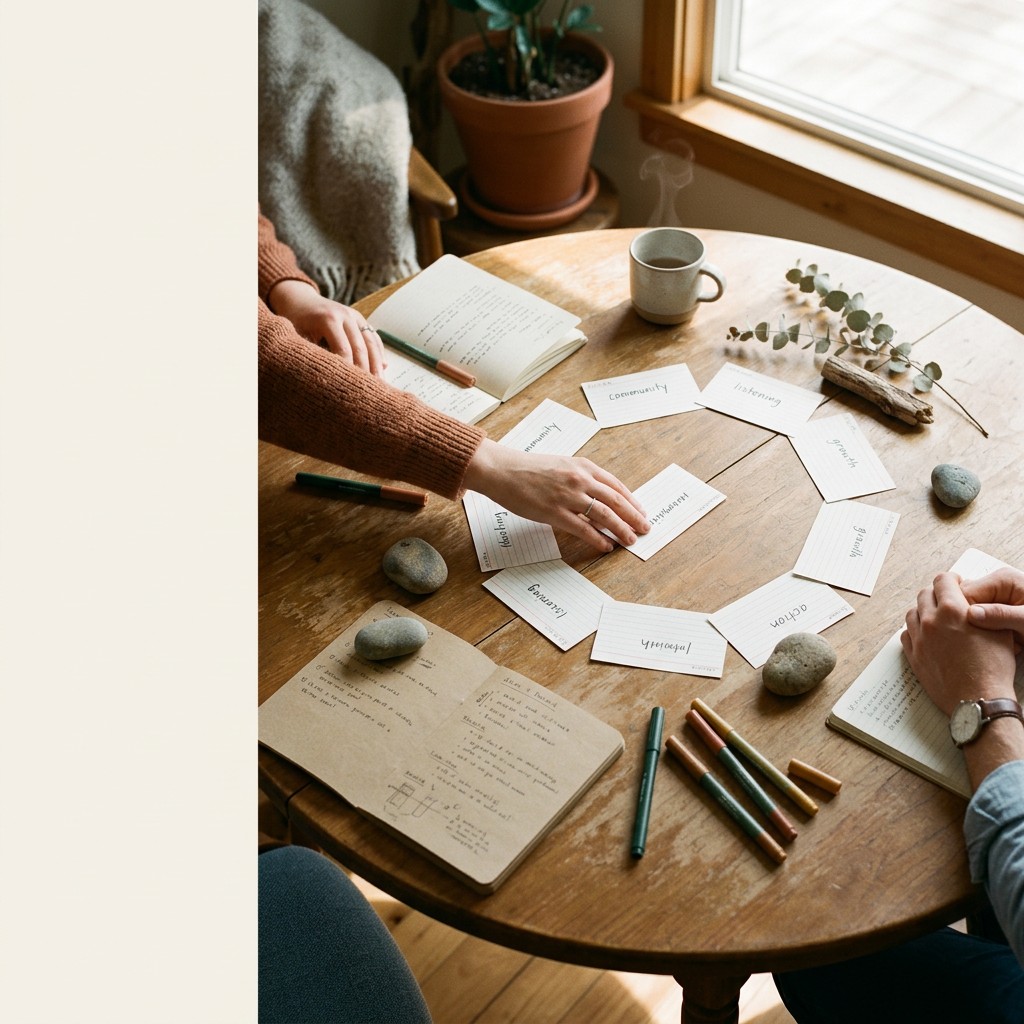
Seven Design Questions for Support
If support is a design practice, then discernment belongs at the center.
These seven questions can help individuals, coaches, families, educators, leaders, organizations, and communities think more intentionally about the support they offer and receive.
1. What transition is actually being navigated?
The visible change may not be the whole transition. A job change may also be an identity shift. A young adult launch may also be a family role shift. A leadership transition may also be a trust transition. A community crisis may also be a memory, safety, and belonging transition.
Support begins with noticing what is really changing.
2. Who needs to participate in shaping the support?
Support is stronger when the people most affected have voice in shaping it. This does not mean every person has the same role, authority, or responsibility. But lived experience belongs in the design.
The person closest to the transition often knows what the support needs to know.
3. What does lived experience already reveal?
People bring history into transition.They may already know what steadies them, what shuts them down, what restores clarity, what creates resistance, what builds trust, and what makes a practice meaningful.
Resistance can also be information: a signal about boundaries, pace, trust, readiness, history, or what the support design has not yet understood.
Support should listen for that wisdom.
4. What practices, structures, or rituals might fortify movement now?
The question is what fortifies.
A practice might help someone pause before reacting. A structure might help a team communicate more clearly. A ritual might help a family mark a role shift. A reflection question might help a client hear what they already know. A resource pathway might help a community move from crisis response toward repair.
Support becomes real when it becomes practice: something people can try, notice, revise, and carry.
5. What real conditions affect access, trust, and capacity?
Support has to account for real conditions: time, energy, money, health, caregiving, transportation, technology, history, identity, institutional trust, and the uneven weight people are already carrying.
6. How will we notice what is working and what needs to change?
Support needs feedback loops.
What is becoming clearer? What is creating movement? What is strengthening capacity? What is being avoided? What is no longer useful? What needs to be adjusted?
Support is not finished when it is offered. It has to be observed, practiced, and refined.
7. How does this support strengthen agency, steadiness, and movement?
Support is working when it helps people become more able to participate in their own lives, relationships, leadership, and choices.
It does not have to remove every uncertainty.
It should help people become more able to manage themselves within the transition, rather than be wholly owned by it.

Support That Carries Forward
Support carries forward when it helps people discover what strengthens them.
That discovery is not always dramatic. Sometimes it looks like a clearer question. Sometimes it looks like a boundary. Sometimes it looks like rest. Sometimes it looks like a next step. Sometimes it looks like a difficult conversation that finally has enough structure around it to happen.
This design lens applies across settings.
In families, support may mean learning a new rhythm of closeness. In organizations, it may mean designing onboarding, supervision, or change processes that strengthen capacity rather than simply distribute information. In education, it may mean helping learners practice reflection, decision-making, and responsibility before expecting polished certainty. In community work, it may mean shaping resources with the people who understand what dignity, access, trust, and repair require.
In coaching, it may mean creating the conditions for a person to hear themselves more clearly, test new practices, and take meaningful steps toward the life, leadership, or transition they are trying to inhabit.
Across these settings, care becomes support when it has intention, participation, and practice.
Support as a Partnered Practice
At Sojourner Strategy Group, this is how we understand coaching, consulting, and transition support: not as something done to people, but as a partnered practice of discovery, design, reflection, and movement.
The work is not to hand people a universal formula for change. The work is to help people notice what is changing, uncover what strengthens them, practice what builds agency, and move with more awareness and steadiness.
Support is a design practice.
It asks us to honor lived experience, attend to real conditions, and treat people as participants in the practices and possibilities that will carry them forward.
It asks us to design care with enough intention that it can become structure, practice, movement, and integration.
If you are moving through a transition and trying to understand what kind of support, structure, or practice would help you move with more awareness and steadiness, Sojourner Strategy Group offers coaching and consulting spaces designed for that kind of discernment.
Support is how care becomes practice.
In Practice,
Antoinette
